The Team

Adam Rana, Project Manager

Jungkyoo Park, Stress Analyst

Ilute Nyambe, Finance Officer
Ravi Parmar, Material Specialist
Arnold Ngang, Chief Designer

Showing posts with label Park. Show all posts

Sunday, 2 May 2010

The group Presentation

Here is the presentation slide containing the information used for the presentation session on Wednesday.


Just want to congratulate the Team on a brillant perfomance and hope that it will be a success.

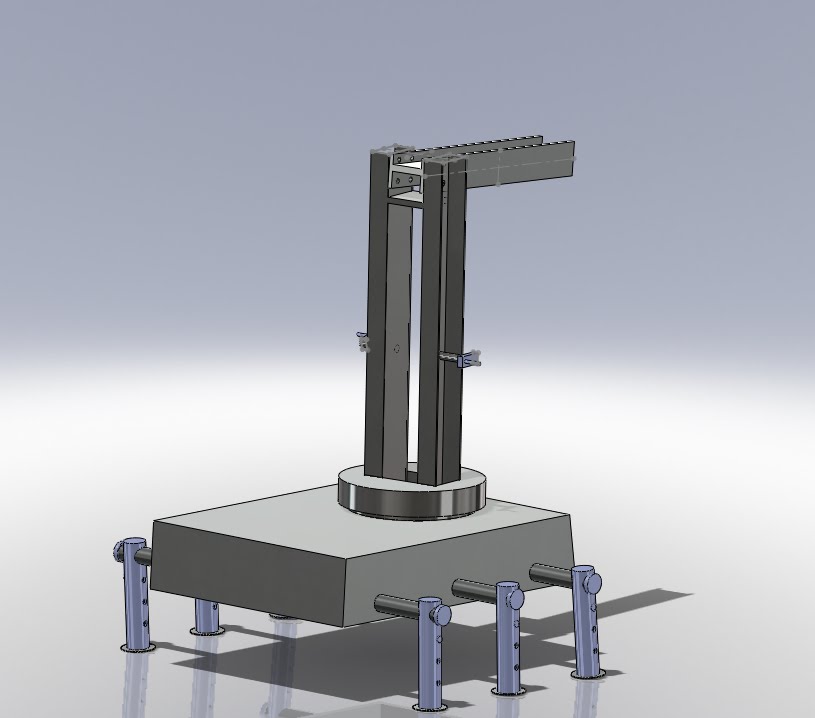
Our final Crane model

After a long period of designing and re-designing we finally finished with out crane model. below is a picture of of the final module.

Thursday, 22 April 2010

Benefits of our crane

Innovate high-performance
applications with versatile Optim
• Achieve higher payloads for lifting and transportation applications.
Ruukki is the only supplier of very thin ultra high-strength steels
from 2.5 mm.
• Create more innovative applications with laser-welded thin, wide
sheets and a broad selection of high-strength sections and tubes.
Create good-looking end-products
with Optim, which has great workshop
capabilities
• Enjoy painless forming of Optim thanks to its minimal yield strength
variation and high thickness accuracy.
• Benefit from easy welding thanks to low alloying of Optim. Increase
welding speed with thinner gauges to save time and money.
• Benefit from excellent surface quality and flatness with our unique
production processes
- direct quenching
- powerful levelling capabilities both for heavy plate and
cut-to-length lines

Wednesday, 21 April 2010

beam's properties

Elastic Modulus 210000 N/mm^2
Poissons Ratio 0.28
Shear Modulus 79000 N/mm^2
Thermal Expansion Coefficient 1.3e-005
Density 0.0078 g/mm^3
Thermal Conductivity 43 W/m K
Specific Heat 440 J/kg K
Tensile Strength 399.826 N/mm^2
Yield Strength 220.594 N/mm^2

Corrosion

Corrosion Theory
Humans have most likely been trying to understand and control corrosion for as long as they have been using metal objects. The most important periods of prerecorded history are named for the metals that were used for tools and weapons (Iron Age, Bronze Age). With a few exceptions, metals are unstable in ordinary aqueous environments. Metals are usually extracted from ores through the application of a considerable amount of energy.
Certain environments offer opportunities for these metals to combine chemically with elements to form compounds and return to their lower energy levels. A modern and comprehensive document on the subject is the second edition of the classic CORROSION BASICS textbook. Some excerpts of that document are used here.
Corrosion is the primary means by which metals deteriorate. Most metals corrode on contact with water (and moisture in the air), acids, bases, salts, oils, aggressive metal polishes, and other solid and liquid chemicals. Metals will also corrode when exposed to gaseous materials like acid vapors, formaldehyde gas, ammonia gas, and sulfur containing gases. Corrosion specifically refers to any process involving the deterioration or degradation of metal components. The best known case is that of the rusting of steel. Corrosion processes are usually electrochemical in nature, having the essential features of a battery.
When metal atoms are exposed to an environment containing water molecules they can give up electrons, becoming themselves positively charged ions, provided an electrical circuit can be completed. This effect can be concentrated locally to form a pit or, sometimes a crack, or it can extend across a wide area to produce general wastage. Localized corrosion that leads to pitting may provide sites for fatigue initiation and, additionally, corrosive agents like seawater may lead to greatly enhanced growth of the fatigue crack. Pitting corrosion also occurs much faster in areas where microstructural changes have occurred due to welding operations.
The corrosion process (anodic reaction) of the metal dissolving as ions generates some electrons, as shown in the simple model on the left, that are consumed by a secondary process (cathodic reaction). These two processes have to balance their charges. The sites hosting these two processes can be located close to each other on the metal's surface, or far apart depending on the circumstances. This simple observation has a major impact in many aspects of corrosion prevention and control, for designing new corrosion monitoring techniques to avoiding the most insidious or localized forms of corrosion.

Tuesday, 20 April 2010

Design assembly ( preliminary stage)


This is the first stage of the assembly of the our final design. The beams are mounted onto the rotating base. This base will contain ball bearings which whill allow the posibility for easy rotation when needed.

Outtriggers for Support


These are the structures that offer support to the crane structure on rough ground.
the holes help in changing levels to match an appropriate height.

Saturday, 17 April 2010

Beam used in Lifting ( top)


This is the rotating beam situated at the top. With the help of the supporting bar, the winge system at the back and the eye bolt, the beam can move up and down to meet target objects before lifting and after lifting.

Note that in the final assembly, it is used as an H-beam. this was to ensure that the beam could be properly mounted onto the main crane supporting structure.

Mechanics and Calculations

Thursday, 15 April 2010

BRITTLE FRACTURE

BRITTLE FRACTURE

what is brittle fracture?

Basically, brittle fracture is a rapid run of cracks through a stressed material. The cracks usually travel so fast that you can't tell when the material is about to break. In other words, there is very little plastic deformation before failure occurs. In most cases, this is the worst type of fracture because you can't repair visible damage in a part or structure before it breaks.
In brittle fracture, the cracks run close to perpendicular to the applied stress. This perpendicular fracture leaves a relatively flat surface at the break. Besides having a nearly flat fracture surface, brittle materials usually contain a pattern on their fracture surfaces. Some brittle materials have lines and ridges beginning at the origin of the crack and spreading out across the crack surface.
Other materials, like some steels have back to back V-shaped markings pointing to the origin of the crack. These V-shaped markings are called chevrons. Very hard or fine grained materials have no special pattern on their fracture surface, and amorphous materials like ceramic glass have shiny smooth fracture surfaces. Chevron Fracture Surface (Callister p. 185)
Radiating Ridge Fracture Surface (Callister pg. 186, copyright by John Wiley & Sons, inc.)

Types of Brittle Fracture

The first type of fracture is transgranular. In transgranular fracture, the fracture travels through the grain of the material. The fracture changes direction from grain to grain due to the different lattice orientation of atoms in each grain. In other words, when the crack reaches a new grain, it may have to find a new path or plane of atoms to travel on because it is easier to change direction for the crack than it is to rip through. Cracks choose the path of least resistance. You can tell when a crack has changed in direction through the material, because you get a slightly bumpy crack surface.


from the lecture note

Mechanics


Wednesday, 14 April 2010

young's modulus of steel

Within the limits of elasticity, the ratio of the linear stress to the linear strain is termed the modulus of elasticity or Young's Modulus and may be written Young's Modulus, or E =(Stress/Strain) It is this property that determines how much a bar will sag under its own weight or under a loading when used as a beam within its limit of proportionality. For steel, Young's Modulus is of the order of 205000 N/mm2.
so it is between 190Gpa and 210Gpa

Monday, 22 March 2010

Tuesday, 16 March 2010

Initial research

Safe working distance from power lines
* when the operating near high-voltage power line *
normal voltage(phase to phase) / minimum required clearance

upto 50kV / 10ft(3.1m)
50 - 200kV / 15ft(4.6m)
over200 - 350kV / 20ft(6.1m)
over300- 500kV / 25ft(7.6m)
over500 - 750kV / 35ft(10.7m)
over750 - 1000kV / 45ft(13.7m)

*while the transist with no boom and load or mast lowered)

normal voltage(phase to phase) / minimum required clearance

upto 0.75kV / 4ft(1.2m)
0.75 - 50kV / 6ft(1.8m)
over50 - 345kV / 10ft(3.1m)
over345- 750kV / 16ft(4.9m)
over750 - 1000kV / 20ft(6.1m)